Speldetails
 Dit is de originele tekst in Engels.
Terug naar de Nederlands vertaling.
Dit is de originele tekst in Engels.
Terug naar de Nederlands vertaling.
Divide the different characters among the players. Players take time to read/watch/listen to the story of one of the characters quietly.
Give the players time to empathise with the role. Encourage them to try to think about the characters' lives, what they say, how their daily lives go, whether they have friends, etc. Put on some quiet music to facilitate this process. You can read out some questions for support (see additional game information).
After empathising with the characters, play an introductory game with the players: ask the players to line up in absolute silence.
In what follows, tell the players that you are going to read some statements aloud (see additional game information for some examples). Each time they can answer "yes" to the statement (based on their character), they must take a step forward. If the answer is "no", they just stand.
Read the statements one by one. Give the players enough time to take a step forward or not after the statement.
After the exercise, the facilitator asks the players to turn around 180° and look at their final position. Then give the group a few minutes to step out of their roles, after which you can proceed to debrief.
Begin the debriefing by asking some evaluation/reflection questions (see additional game information for examples).
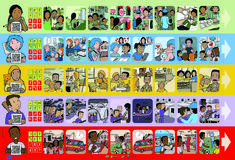
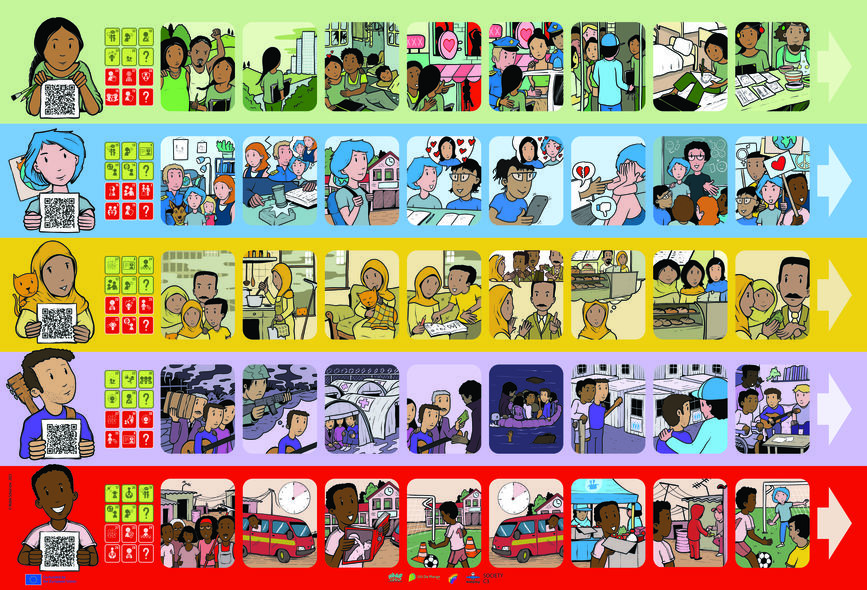
The stories of the five characters poster show the storylines of the five main characters of the toolkit. The full storylines of the characters can be found in the appendix of the activity bundle. On the left-hand side of the panel, the main characters are shown with a QR code one can scan to listen to their story in different languages. Next to the characters, six green rights and six red rights are depicted. These icons show the main children's rights which are respected and violated in the story of the specific character. In order to interpret the children's rights icons, it might be useful to always have the children's rights overview panel with you.
All children's rights icons used on the posters are created by UNICEF for their child-friendly version of the Convention on the Rights of the Child.
For StreetSmart Wheels partners, the code of the poster is SOCIETY-C3
Als je dit spel hebt gespeeld, help dan andere mensen te informeren door een beoordeling te geven.
Aarzel niet om je feedback te delen en help anderen om de juiste spelletjes te kiezen. Vertel ons hoe het was en hoe de kinderen reageerden? Of heb je advies voor andere spelers, een leuke variatie, een mogelijke verbetering?

Wij waarderen het zeer dat jij de moeite neemt om een recensie te schrijven.

Speldetails

Speldetails

Speldetails
Opgeslagen cookies