Speldetails
 Dit is de originele tekst in Engels.
Terug naar de Nederlands vertaling.
Dit is de originele tekst in Engels.
Terug naar de Nederlands vertaling.
Stap 1
Small paper notes containing the names of animals depicted on the poster. You can prepare some cards (like playing cards) depicting individual animals, especially for younger children.
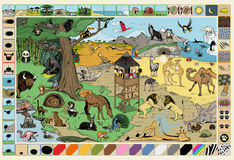
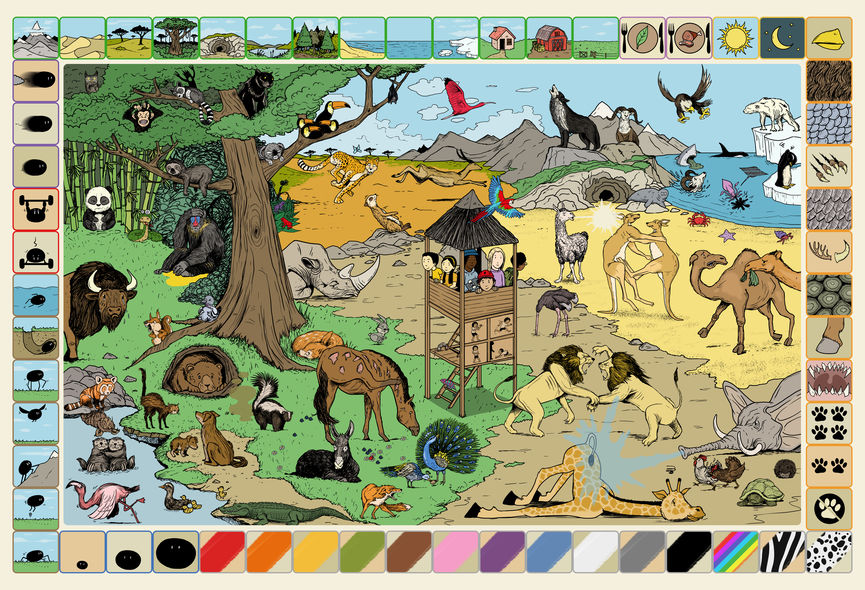
The poster features the following animals: chipmunk, eagle, lions, kangaroos, chimpanzee, chickens, turtle, hedgehog, sloth, cheetah, bear, ducks, gorilla, rhino, flamingo, dog, camels, peacocks, deer, otters, donkey, bison, wolf, snake, polar bear, pigeon, shark, meerkat, giraffe, bunny, toucans, owl, cat, black panther, koala, llama, panda, red panda, lemur, ostrich, penguin, horse, argali, elephant, fox, skunk, cuttlefish, bat, red crab, ladybug, mouse, killer whale, seal, eagle ray, chameleon, red frog, purple frog, purple hermit crab, parrot, scarlet ibis, crocodile, sea star.

Divide the players into teams, ensuring an equal number of players in each team.
Start the round by providing the deck of cards with the animals of the poster to the first person of group 1 and set a timer on for example 1 minute.
This designated player will take the first card from the deck and offer clues to his team members by placing the caps or pawns accordingly on the corresponding categories. The other team members analyse the clues and try to guess the animal, making sure they stay within time.
If the group guessed the animal, the designated player could take a second card if there is still time left on the timer.
Once the timer runs out, tally up the number of correct guesses for this team. Now the next team can designate a player, and the timer is again set on for example 1 minute.
At the end of each round, tally up the number of correct guesses for each team. The team with the most correct guesses wins the round.
Continue playing additional rounds with different designated guessers until all team members have had a turn.
At the end of the game, each team counts its winning rounds. The team with the highest number of wins is declared the winner.
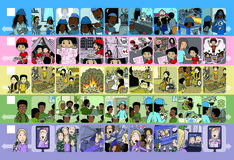
The "Stress Discovery Channel" poster depicts animals in different emotional/behavioural states. On the border of the game board, you can find different characteristics that can be linked to animals. Each characteristic has a coloured border. The characteristics with the same-coloured border, belong to the same category. The icons are depicting (starting from top left clockwise):
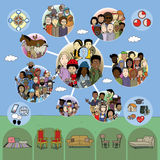
The centre of the poster depicts different animals with different stress reactions. The animals depicted and their stress responses are:
The following games can also be played with this educational poster:
This game is part of the toolkit ‘Facing trauma - A toolkit on trauma-informed support for children and youth’. This toolkit is a cooperation between StreetSmart, Minor-Ndako, Save the Children Romania & SolidarityNow, cofinanced by the European Union. It provides simple tools to explore important topics like trauma, stress, self-care and emotions in a way that’s easy to use with different target groups.
* Instead of using the clues on the border of the poster to guess animals, the players act out the behaviours or characteristics of different animals while their teammates guess the animal being portrayed.
* Create a set of cards with pictures of animals and their corresponding emotional/behavioural states on the poster. Place the cards face down and take turns flipping them over to find matching pairs of animals and emotions.
* Provide a collection of animal pictures along with emotion words or phrases. Participants work together to match each animal with the emotion they think it represents, discussing their reasoning as a group.
* Assign each player an animal and ask them to role-play the behaviours and emotions of that animal. Encourage them to express themselves through movement, sounds, and facial expressions.
*Have players create stories or narratives featuring animals as characters, incorporating different emotional themes or situations related to trauma and resilience, coping, and support within their stories.
Als je dit spel hebt gespeeld, help dan andere mensen te informeren door een beoordeling te geven.
Aarzel niet om je feedback te delen en help anderen om de juiste spelletjes te kiezen. Vertel ons hoe het was en hoe de kinderen reageerden? Of heb je advies voor andere spelers, een leuke variatie, een mogelijke verbetering?

Wij waarderen het zeer dat jij de moeite neemt om een recensie te schrijven.

Speldetails

Speldetails

Speldetails
Opgeslagen cookies